
On Science, Democracy, and the Courage to Speak Up
I read recently that Heather Cox Richardson stays up till 4 AM most nights writing because people sleep better after reading her words, myself included. We’re a year into this chaos, or over a decade or several if you know your history, and I’ve been swirling around in my own mind wondering what I can do. I am no Heather Cox Richardson, but I need to do my part. I have been mulling over what exactly my part is for the past year, or more if you knew my history. They say to write about what you know. I know science. And that is probably a good enough place to start, given the current state of it. I’ve been writing in private this past year, when I can sneak a free moment or two. I’ve even laid out a whole series of topics I want to write about and have started a few, but I’ve been hesitant to share them publicly.
But every night when I go to bed, exhausted and too often horrified, I lament another day that has passed without me writing. Another day has passed without me sharing my thoughts with you. I’ve been holding myself back, talking myself out of it. Even beyond my fear that you will not care about what I have to say, I think my greatest fear is that I will not be able to keep up. That you would like what I have to say, and I would fail you all.

I have a lot going on in my life: a single mom of two middle schoolers with busy schedules, a professor at a prestigious medical school and full-time researcher concerned about how I will continue to support my team. I am a leader, a mentor, a daughter, and a partner. I have a full plate, I convinced myself it was enough of a stand to simply be doing science. But these are all just excuses for the fears that have been holding me back. The truth is I feel helpless and I feel broken. But I feel the urgency of this time to do something.
“Science is the process of seeking truth and is the foundation of democracy”
In the early days of the Covid‑19 pandemic, science education researchers at King’s College London published a critical piece supporting a science “pedagogy for democracy” (link here). At the time, many of us were searching for clarity wherever we could find it. They ask whether science education could stand against views commonly espoused by fascist ideologies and lay out a clear case for why “fascism is science educators’ business.” When I first read this, I had to stop and sit with it. It is a bold claim, but upon reflection, not an exaggeration.
History teaches us that “apolitical” scientists can be swayed to legitimize authoritarian ideologies. When we pretend that science is neutral, as many of us have for far too long, we open the door to the misuse of science for authoritarian purposes. And scientists who do not toe the line are shut out. It’s a pattern we’ve seen repeat across continents and decades. During Germany’s Nazi regime, in Salazar’s Portugal, and again in Bolsonaro’s Brazil. And we can see this happening in real time, right now, in the United States. At first it is gradual, almost imperceptible. Then it comes all at once.
“Should science education deliberately and clearly stand against authoritarian, intolerant, oppressive, misogynist, and racist views, promoted and valued by fascist ideologies?”
Galamba & MatThews, 2021
“In order to be able to contribute to democracy students need to understand the complexity and the social processes of science.”
And this history complicates the story we like to tell about how science works. Contrary to outside perspectives science is not purely objective, and it is certainly not apolitical. With the recent weaponization of information and the strings attached to scientific research funding, I don’t think we can pretend otherwise anymore. Their conclusions aren’t easy to hear, but they’re necessary. It’s difficult to hear the authors’ evidence linking STEM education with less social concern and fewer social or civic values of the students. How science and scientists have ignored or exploited (or worse) issues of race and homosexuality. And of course, the misogyny.
I’m ashamed to say that while I’ve always been aware of this history, in recent years I’ve taken too much solace in the improvements we’ve made, and in a perhaps false belief that “that happens in other, more male‑dominated fields.” Perhaps I’ve been sheltered in a Pediatrics Department (we can unpack another time why that grossly underpaid field of medicine is so heavily skewed toward women). At any rate, with the recent revelations about prominent male scientists entangled with Epstein, I can no longer be quiet. At some point, looking away becomes complicity. So I’m choosing, however imperfectly, to speak into this.
Still, naming the harms is only the beginning. Beyond misogyny, homophobia, racism, and other exclusionary ideologies within science, the authors lay out how a humanized approach to scientific literacy can strengthen the foundations of democracy: empathy, inclusion, and tolerance. Teaching and communicating science must highlight these social contexts: the collaborations, the uncertainties, and the honest truth about what science does and does not say, rather than presenting science as a detached, zero-sum venture. It is time to enhance not only our collective understanding of science in this world, but our awareness of who is studying and who is funding the research.
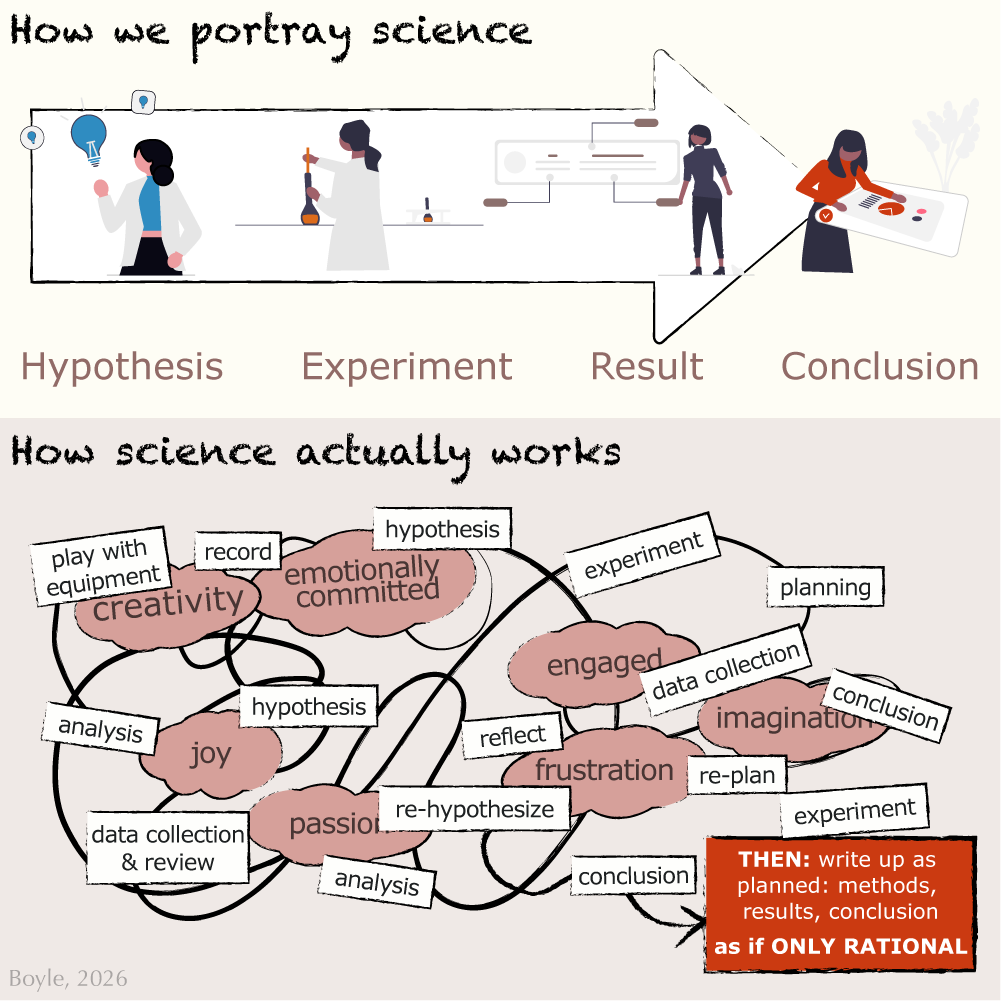
The top panel shows how we as scientists and the public portray scientific research, as a clear linear path from hypothesis to conclusion. The bottom panel, adapted from Galamba & Matthews1, shows the emotional and uncertain reality of science.
The humanized view of science that the authors describe, one that accepts social and cultural contexts alongside logic, is a reminder of what science can be at its best. This vision is not simply theoretical; it’s deeply practical, appealing to a more diverse group of future scientists. It will shape how all of us who learn about science interact with the world around us. The authors call on us to view and educate about science as a social activity: how we do science. Our collaborative work, our uncertainties, our dreams and ambitions.
While the authors were largely speaking to the education of future scientists and citizens–our current or future students–I see my job as bringing this to people who finished their “science education” long ago. Whether that was in 10th grade or postdoctoral training. I’d love to introduce you to the human side of science. I’m here to show you the uncertainties, the indecision, and the human complexities that underlie scientific research. A lifelong morning person, I certainly can’t stay up till 4AM, I do think I could get up at 4AM to share this with you.
Follow along as I write about science, truth‑seeking, and the world we’re navigating together.
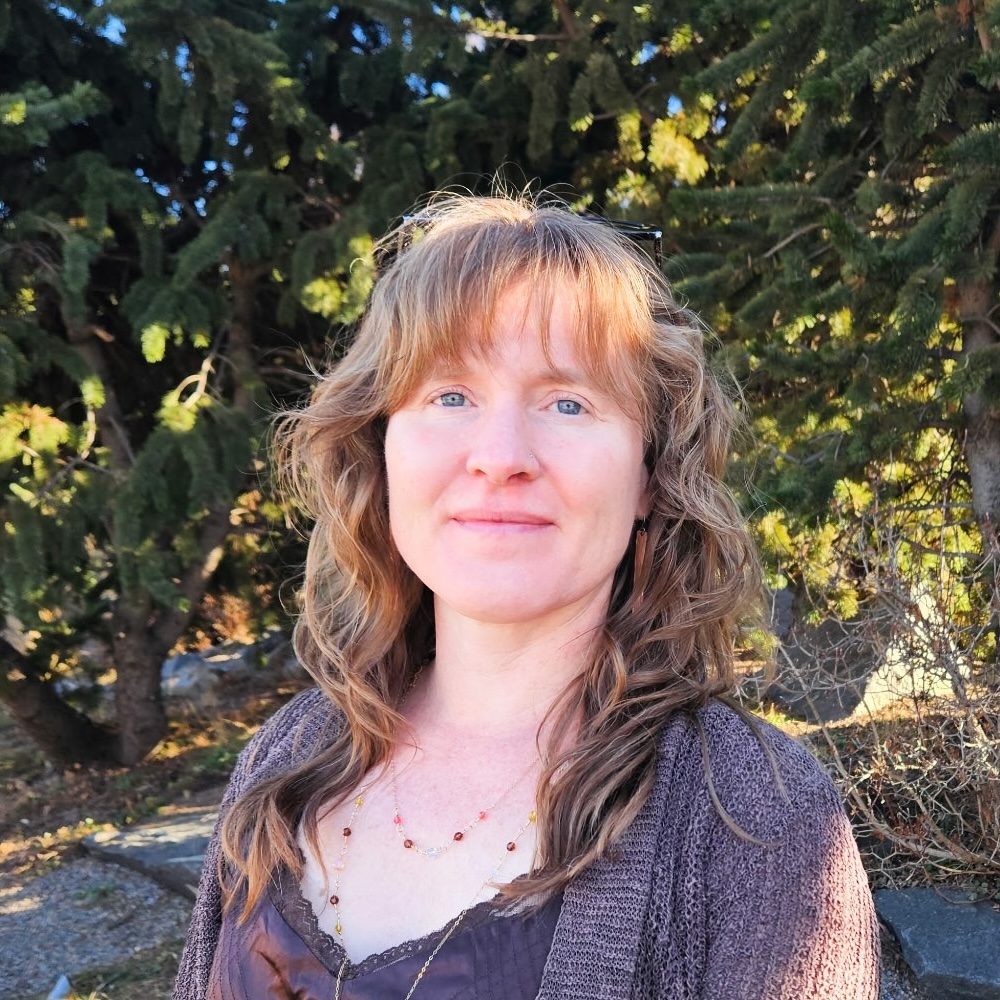
Kristen Boyle, PhD
Dr. Boyle is a scientist, writer, and professor at the University of Colorado Anschutz School of Medicine, where she leads the Molecular Health Lab. Her group studies how early life shapes lifelong health. She writes about science, health, truth, and humanity.
Linked References
- Galamba, A., Matthews, B. Science education against the rise of fascist and authoritarian movements: towards the development of a pedagogy for democracy. Cult Stud of Sci Educ 16, 581–607 (2021). https://doi.org/10.1007/s11422-020-10002-y ↩︎